
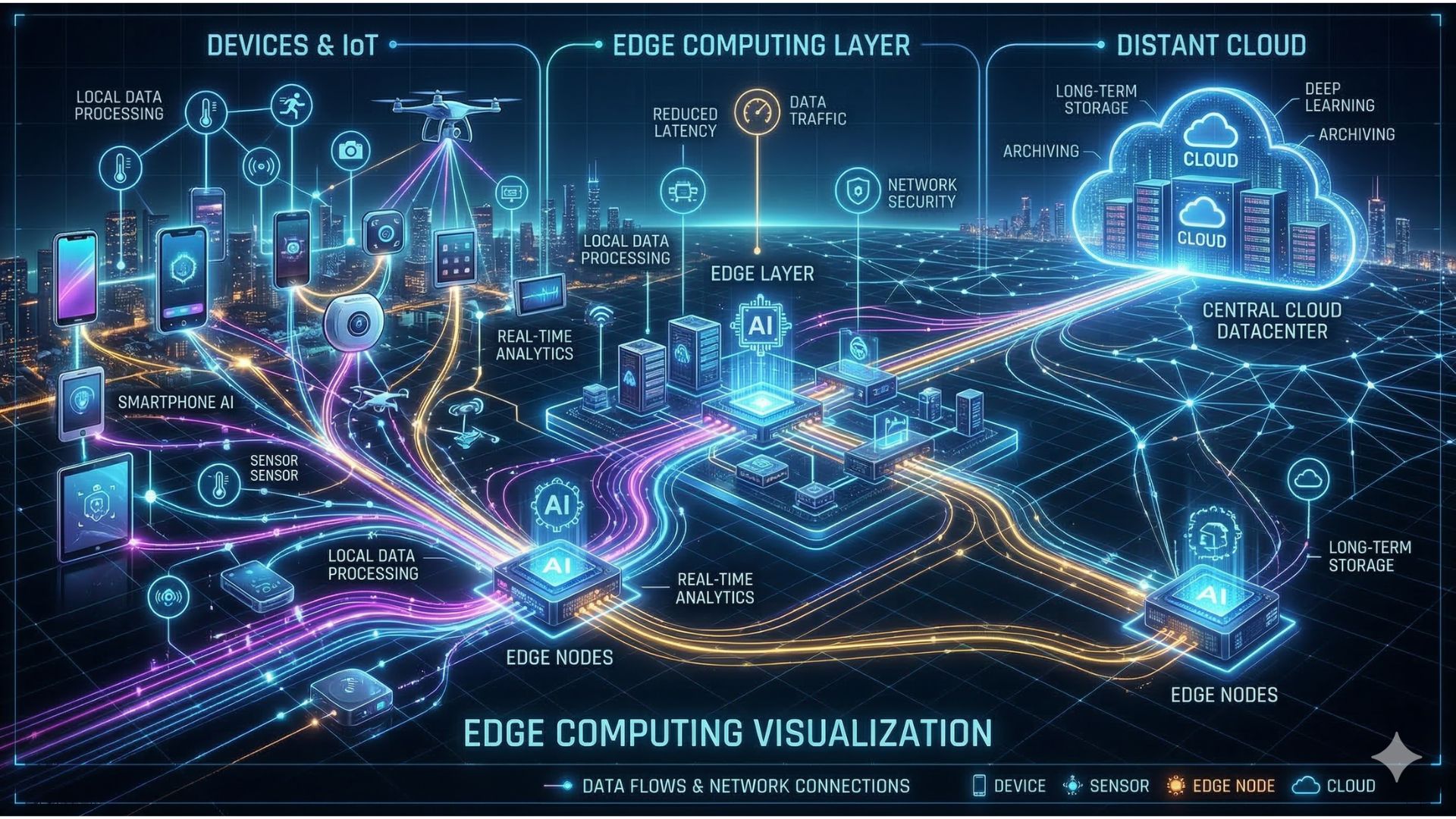
Over the past decade, cloud computing has been the backbone of digital transformation. Businesses have relied heavily on centralized data centres to store, process, and manage information. However, in 2026, a new shift is gaining momentum — edge computing.
Instead of sending all data to distant cloud servers, edge computing processes data closer to where it is generated. This evolution is redefining how modern applications are built, delivered, and scaled.
Understanding Edge Computing
Edge computing refers to a distributed computing model where data processing happens at or near the source — such as devices, sensors, or local servers — rather than relying entirely on centralized cloud systems.
This approach reduces the distance data must travel, resulting in faster processing and improved performance. As applications become more real-time and data-intensive, this shift is becoming increasingly necessary.
Why Edge Computing Is Growing Rapidly
Several key factors are driving the rise of edge computing in 2026.
First, the demand for real-time processing is increasing. Applications such as online gaming, video streaming, IoT devices, and smart systems require immediate responses. Even a slight delay can affect user experience or system performance.
Second, the rapid expansion of Internet of Things (IoT) devices is generating massive amounts of data. Sending all this data to the cloud is inefficient and costly. Processing data locally reduces bandwidth usage and improves efficiency.
Third, concerns around data privacy and security are pushing organizations to keep sensitive data closer to its source. Edge computing allows businesses to limit exposure by processing critical data locally instead of transmitting it across networks.
Edge vs Cloud: A Shift, Not a Replacement
It is important to understand that edge computing is not replacing cloud computing — it is complementing it.
Cloud platforms still play a vital role in large-scale storage, analytics, and system management. However, edge computing handles time-sensitive tasks, while the cloud manages long-term processing and coordination.
This hybrid approach creates a more efficient and scalable architecture, combining the strengths of both systems.
Real-World Applications
Edge computing is already being used across multiple industries.
In telecommunications, it supports faster network performance and improved connectivity.
In healthcare, it enables real-time monitoring of patients through connected devices.
In retail, businesses use edge systems for faster payment processing and personalized customer experiences.
In smart cities, edge computing helps manage traffic systems, energy usage, and public safety in real time.
These applications demonstrate how critical low-latency processing has become in modern systems.
Opportunities for IT Companies
For IT companies and developers, edge computing opens up new possibilities.
Businesses can build low-latency applications, optimize system performance, and reduce cloud dependency costs. There is growing demand for services such as edge infrastructure setup, system integration, network optimization, and hybrid cloud-edge solutions.
Companies that develop expertise in distributed systems, networking, and real-time processing will have a strong competitive advantage in this evolving landscape.
Challenges to Consider
Despite its benefits, edge computing also comes with challenges.
Managing multiple edge devices and nodes can be complex. Security must be maintained across distributed systems, and infrastructure costs may increase initially.
However, as technology matures, tools and platforms are improving to make edge deployment more efficient and scalable.
Conclusion
Edge computing is redefining how data is processed in 2026. As the demand for speed, efficiency, and real-time performance continues to grow, businesses are moving beyond fully centralized cloud systems toward a more distributed approach.
For IT companies, this shift represents both a challenge and an opportunity. Those who adapt early and build expertise in edge technologies will be better positioned to deliver faster, smarter, and more reliable solutions in the future.
Leave a comment: